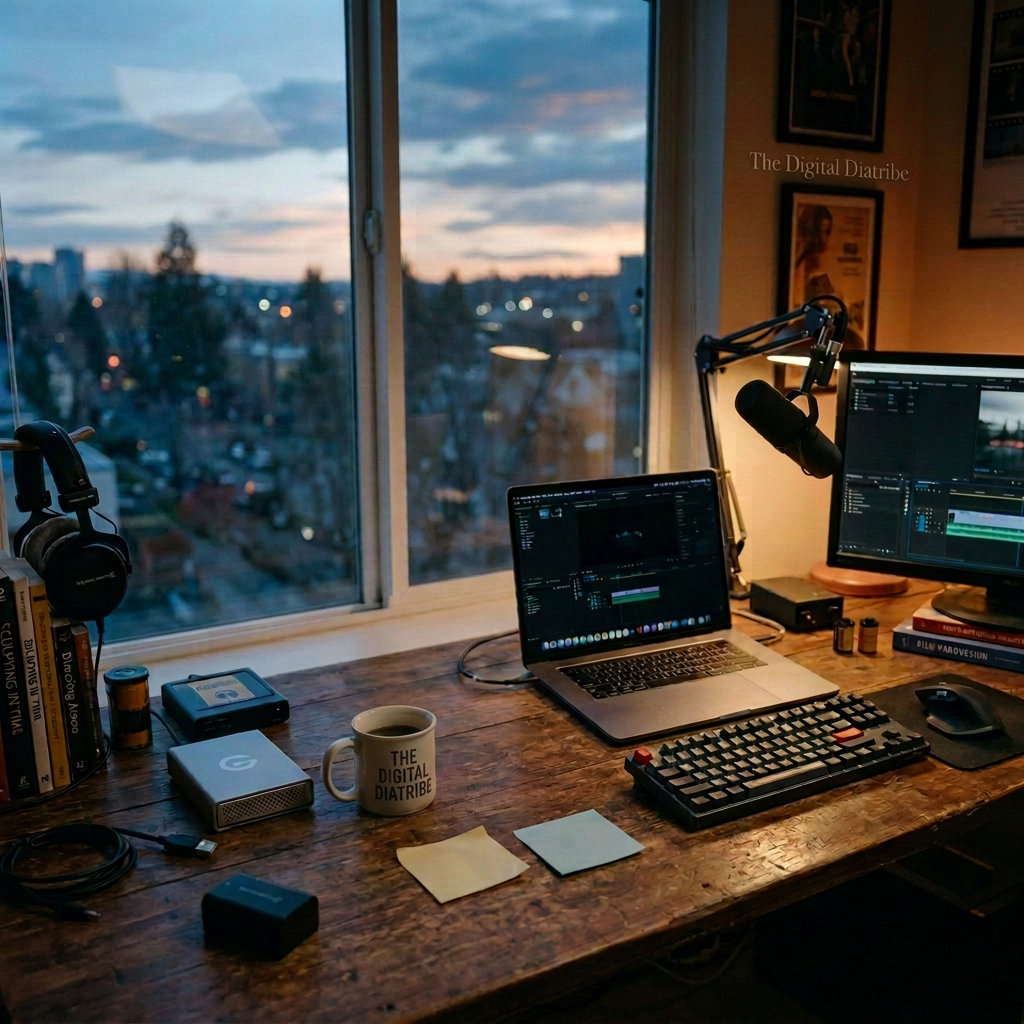
What does it cost to say the thing you’ve been avoiding for twenty-two years? I don’t know the exact number. But I can tell you what an average week costs me first. By every standard metric of modern capitalism, what I am doing is completely unhinged. I write two essays a week, manage a blog, Substack, and multiple social media pages. I write an average of twenty sales pitches for guest interviews, unpaid speaking gigs, as well as at least twenty book consignment deals a week. This morning, I wrote six podcast pitches and one essay to offer my services.
I manage and monitor four book sales outlets that are actually moving a few books as well.
This takes about 40 hours a week to do, and thankfully, it’s not my job. Not because I wouldn’t want it as a job, but because not only does it not pay, I lose money at it.
But I love what I do.
And now, I’m working on adding a podcast.
This is not a new venture, just a natural extension of what I’m trying to accomplish here as I pull myself further and further out of my comfort zone and into the unknown. It’s not unknown because of a lack of vision. I have a clear vision of what I want to do. It’s unknown because I do not know who cares, if anyone.
And this is the economy of the creator.
If you’ve stuck with me this long, welcome to The Digital Diatribe. You’re my audience, and I appreciate both of you.
But this is not a sprint; it’s a marathon, and the distance is what scares me.
The commodification of self takes a high toll.
If you have ever felt compelled to do something, or maybe “driven” is a better word to describe the relentless push to bring an idea to life. You may relate to this post.
Earlier this year, 2026, I went home for the first time in 17 years. It was a surreal experience, and it felt like I was saying goodbye, even if I didn’t know to whom or what. I saw some cherished friends and family and visited some places that broke my heart to see. Most of the three days, however, were in silence. I felt compelled to write when I left, to build something. It was time to write the story about Stacy—the last story. The one I had been holding onto silently for 22 years.
I talked about it briefly with one or two people, but mainly, I just kept my head down and wrote. Then I went to work trying to figure out how to get it published. I needed to do this. Nothing else in my life has ever been so clear.
I needed to say goodbye.
Grief had become my identity long after the initial wounds had healed. I grieved for Stacy, but I also grieved for what might have been, an imaginary place I would return to, unknowingly, unwillingly, time and time again when life would become hard. And life is frequently hard.
I felt compelled to share this with all of you, to share this with the world at large, really. Not so that you would look at me differently. Truth be told, I’d rather you not look at me at all most of the time. But here I stand, holding up the ugliest parts of me for everyone to see.
So why?
I’m trying to be a better dad, a better husband, a better friend, and a better person. This process has helped me see myself from an unflattering angle, but an angle that needed to be exposed. And you know what? It hasn’t killed me.
If anything, it has set me free.
So many people over the years have told me to “let it go.” Bless their hearts “in the most southern tone I can muster’’. That’s just not possible. The only way through a thing is to go through it. So the point in sharing this is so that you know you can walk through whatever you need to as well. Because sometimes we need an example.
Sometimes we need to be the example.
Tennessee Williams, in his work A Separate Poem, wrote:
But under the silence of
what we say to each other,
is the much more articulate
silence of what we don’t say
to each other, a storm of things
unspoken, coiled, reserved,
appointed, ticking away
like a clock attached
to a time-bomb: crash, fire,
demolition wound up
in the quietly, almost tenderly,
small, familiar things unspoken.
No matter how hard I try, no matter how inspired I feel, I’ve never written anything so articulate. But this is what I want to do, what I need to do: talk about the things unspoken.
Read Next
The Digital Diatribe runs on black coffee, hopes, and dreams. Unfortunately, keeping the lights on also costs actual money. If you like what you read and feel like buying me a coffee, I’d appreciate it. No pressure.
Want to know when the next post goes live? Subscribe for notifications. Subscribing is always free.
Leave a Reply