Two weeks to flatten the curve. Saturday, March 21, 2020, at 5:00pm that was the directive we all received. I had been sober for a little over two years at this point and while I was not over concerned that I was going to start drinking without going to a meeting, a lot of people were and that was a legitimate concern for many, especially the newcomers.
I was very actively involved in AA at this time, and my phone was ringing non-stop with the same question every time “What do we do?” I’m not sure I was ever qualified to answer that question, but I know what me and a friend of mine did. We started a Zoom meeting and private Facebook group for everyone in our district and all the groups, and started holding meetings on Zoom.
I do not know where that idea came from. I don’t think we were the first, but we were the first I heard about. I know the idea spread like wildfire and is still burning strong today. I watched people attend their first meeting on my computer screen and get and stay sober. And this happens every day all over the world now. It was from our hearts because we just wanted to help. I had the privilege of being involved with a few like-minded people who just wanted to carry the message, and I’ll always be grateful for that experience.
But my sponsor did not see it that way.
Our daily phone calls became 20 to 30 minute calls about how Zoom was not okay. I would hear about how I should not have opened it up to everyone because the message was getting diluted from other groups. Those “other people” were not working the program, and they had to be miserable, and that was not what we wanted people to hear.
Two weeks turned into 69 days, and none of us walked out of our homes the same way we went in.
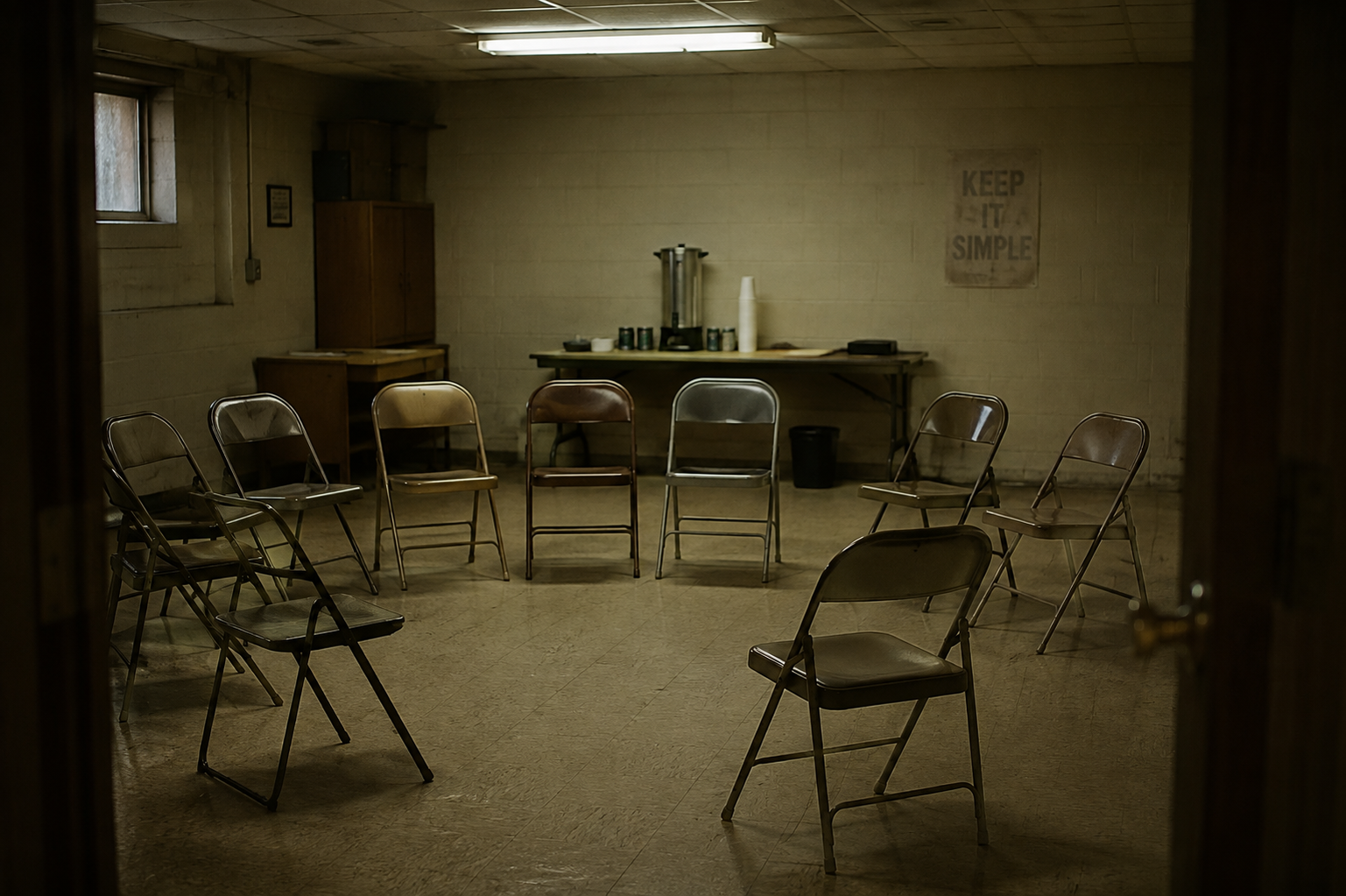
There was an unspoken assigned seating at the 8pm meeting. My sponsor had a seat, everyone knew it and he saved seats for all the guys he sponsored, and I always sat next to him. I had sat next to him at every meeting since 2014, but now I did not have a saved seat at all. During the lockdown the group had split into several small factions that mainly fought about the legality of the lockdown and in-person meetings vs Zoom and while I was not involved in any of that, I no longer had a place at the “dinner table”. It was a painful cut, one I had seen inflicted on many people over the years. But being on this side of it hurt, and it needed to honestly. I would have never seen the truth otherwise. About this same time, I started hearing things through the grapevine about myself, things only my sponsor knew. I had heard him tell other people’s secrets many, many times, but when I was “the trusted” one, I never dreamed it would happen to me.
Though I was not formally cast out, my phone stopped ringing, and I knew why. I didn’t have to speculate about why because people told me. “He doesn’t like you,” and I knew they were hearing the same thing I had heard about so many people for so long. “Why would you talk to him? He’s clearly crazy and miserable” and on and on. I was the new pariah.
Going to meetings at other groups in town was its own issue. One thing you learned quickly was to never tell people where I had been going to meetings before unless I wanted to hear the “Kool-aid” line and be ignored there too. So I would just go and sit quietly because I didn’t want to talk about it. I didn’t want to talk about it because I was far enough removed from the forest at this point to see the trees. I knew they were right, and at the same time, I was heartbroken, and I just wanted back in. I was like leaving an abusive relationship, and I would hold on to that fight for a little over three more years.
But I would find another sponsor in 2020 and start attending different time slots and going to different groups more often than not. The break was official, but the breakup was slow and painful.
This break in my routine, in which I had been so grounded, was the only jolt I needed. My eyes started to open to the idea that maybe everything I thought I knew was wrong. It turns out it wasn’t all wrong, but I needed to look at it as if it was.
Why do I attend Meetings?
This became the question that would dominate my thoughts at every meeting: “Why am I here?” Meetings had been an almost purely social function for a long time. For so long, in fact, I was not even aware it was happening. Now when I would show up at a different time slot with people I did not know, at least not well or frequently, in an almost empty room, my mind would race.
So I dove further into the book. I read the Big Book the first time when I was 16 years old in 1994. Now, in 2020, we were on a new edition, the fourth edition, but the first 164 pages had not changed. But this time I didn’t start with the preface. I started with Dr. Bob’s Nightmare.
- Trust God
- Clean House
- Work with Others
That was why I was there. I’ll be completely honest here, the trusting God part then and now seems a bit abstract to me, but I could sink my teeth into cleaning house and working with others, so that’s what I did.
I had started sponsoring people at six-months sober, so this was not new to me. What was new, however, was not having a constant influx of new people to work with because I was no longer part of the “popular” meeting. About this same time I was becoming a parent to a newborn again, and my attention was more focused on being home and not at a meeting every night. Someone would pull me aside or make it a point to point out how they have not seen me and usually say something like. “People’s lives get better here and they think they no longer need to go and then they get drunk and wonder why.” And when you’ve heard that hundreds, if not thousands, of times and now it’s directed at you, you start to wonder, “Am I going to drink?”
My experience has been no, I’m not.
I’m not special and I’m not immune, but I do try to follow those cleverly hidden simple rules mentioned in the Dr. Opinion.
The Simple Rules
So, what are the rules? They are not written in the book anywhere, not in a clean list at least. I don’t think this was an intentional omission as much as poor editing. The longer I write and the more I work with editors, the more I realize the value of someone else keeping track of the things I said I would talk about, it’s hard to do on your own. And while the big book claims it was written by the first 100. History suggests there were only around 40, but 100 sounded better. And more to the point, it wasn’t a real committee process. The book was written almost exclusively by Bill Wilson.
Here’s what I believe those rules are, and I believe most would agree.
- Total Honesty About Your Condition: (admitted complete defeat over alcoholism) you have to completely give up the illusion that you can control or enjoy your drinking, and be brutally honest with yourself about your own defects. (Chapter 5.)
- Clean Up Your Past: (housecleaning) Written inventory, write down your resentments, fears, and harms; discuss them out loud with another person; make direct amends. (Steps 4–9 Chapters 5–6).
- Practice Daily Self-Examination & Connection: Pause when agitated, review your day, apologize when wrong, ask a Higher Power for direction. (Steps 10–11 pages 84–88).
- Help Other Alcoholics: Actively work with and help other alcoholics without expecting anything in return. (Step 12, Chapter 7).
I’ve personally taken that last one a little further. I do not believe I got sober to hide from my family in a meeting. I’m not sure what the real difference is between never being home or involved with my kids because I’m at a meeting vs a bar. Bill wrote about this idea in several places “vital demonstration of principles within our respective family lives and domestic affairs.” I’ve taken that to mean that my first responsibility is in my home. My job is to be of maximum service to my wife and kids because if I’m putting you before them, I’m still treating them like they don’t matter. I’m still treating them like I did even though I didn’t mean to when I was drinking. So, being helpful, I can and should do that wherever and with whomever I’m with.
Is AA a Cult?
In part one, I said I would do my best to withhold my judgment throughout this process. I’m not the best judge of that. I’m sure my frustration with some past events has shown through, even though that has not been my intent. I’m honestly okay today and have been for a very long time now. At some point, however, I have to address the elephant in the room, and I think that time has arrived. And my answer is a simple no. AA is not a cult, not a program, or an institution. However, the principles that are in place to protect AA from the individual (The Traditions) leave the most vulnerable of us all, the newcomer, in a potentially dangerous place. Everywhere from the obvious dangers that new women face with predatory men. And even sometimes men face those dangers as well. To the less obvious dangers of someone who is completely broken mentally and emotionally being manipulated and controlled by the power-hungry.
And this is the point where I will say definitively: I’ve never met a megalomaniac in AA. Whom I have met, however, are scores of people who, just like me, have sometimes acted impulsively and have gone unchecked because of fear. The very thing the book warns us about as well. It’s hard to watch people die and in AA, you watch a lot of people die. I used to see this as megalomania, and I’ve often heard it called the same. I confess, there was no way to take you on this journey with me without taking you through the same mental arc I’ve traveled over the years. But today I think I see this for what it is: the evil and corroding thread Bill W talked about; it’s unchecked fear. At some point, quite unconsciously, we get a little more guarded, maybe a little more controlling, and we do this because the pain becomes too much. And this is the point when left unchecked we start causing more harm than good, where we send more people out the doors to die, than we lead to a solution that really works. Mea culpa.
I Am Responsible
The responsibility statement in AA is one of my favorite things, and that’s because someone took it to heart, and that’s why I’m here. My first sponsor ever did this, and everyone I ever had did this. And while some may have been misguided, I honestly believe that their hearts were all in the right place. I think they truly wanted to help me. I suspect along the lines I’ve done as badly if not worse, and like my sponsors over the years, I never meant anyone harm. I was just afraid to watch them die. The first time you lose someone you worked closely with, it changes you, and it takes some time to see that in the right light. But the statement still stands. “ I am responsible. When anyone, anywhere, reaches out for help, I want the hand of A.A. always to be there. And for that: I am responsible.” And that’s what we do about newcomers. We keep showing up and making sure someone is offering to just talk about their experience, strength, and hope and nothing else. It’s the only thing any of us are qualified to talk about.
Breaking the Chain of Meeting Culture
Maybe none of this has ever happened to you, and that’s okay. It’s good, in fact. It has been my story and my journey, however, and it’s why I’ve felt the need to write about it. In part 1 I stated “I want to talk about how we break that chain. I want to look at the few simple rules that actually matter, do the work, and then step out of the “rooms” and back into the world.” And we have talked about that a little throughout this series, but never directly.
In 2024, my family and I moved to a new city. It was not a cross-country trek; we only moved about 15 miles, but it might as well have been 1000. We now live in an area with a few meetings, but they are at times when we can not attend, not on any kind of regular basis. Sure, we can drive to later meetings, and we do sometimes, but this is also not without issue. We have four kids, and two of them are very young.
I didn’t need to hear the rumors to know what people were saying because I was thinking it too. “If I’m not at a regular meeting, I’ll be drunk soon.” I heard the rumors and they really just helped compound that fear. An irony of sorts in AA: work the program to be relieved of the bondage of fear, while the message gets driven home with ‘do this or you’ll drink.’ And the fear was alive and well in me.
In 2020, I was sitting in a Zoom meeting during COVID, the first time the thought hit me: “What if there’s nothing wrong with me?” The thought hurt. I mean it physically hurt my head. It came in like a bolt of lightning and left me feeling confused and,based on everything I had been told to that point, afraid I was going to drink. I sat quietly with that thought for a long time, trying to piece together what it might mean. I kept coming back to steps 6 & 7 and this most basic idea of humility, being right sized. Not better than you, not worse, just another human being trying the best I know how with what I have to work with.
That thought never left me, and it deserves more time than I have to give it here, but it led me to a place I needed to be. A place where I was ready to talk to the people who started finding me in 2024. I’ve always sponsored people. It’s one of the simple rules, but now the people I work with or more specifically, the ones who find me, have changed. People who had been around for a while, who were sober and reasonably happy. People who are asking themselves questions that are considered taboo inside the rooms. Questions like “Do I need to be at a meeting every day?” or “Why should I call my sponsor every day?” And while the actual list is much longer, and the conversation is much deeper, the common thread is: “I don’t know where I belong, something isn’t working.” A lot of the people I talk to have the same fear as my dad, the same as I’ve had: that AA is a cult. Just like my dad, I only saw part of the picture for a long time. I needed more information to answer that question.
My response to people now is always the same. If what you’re doing is working, great, keep doing that. If it’s not, however, maybe there’s another way, and I’d be glad to help you find that together. I do not have any answers, just my experience. My experience, however, is this: I’m free.
If I still have your attention, subscribe. It will not cost you anything. Also, leave a comment and share this with someone else if you think it would be helpful. You’ll get emails anytime I post anything new.
The Digital Diatribe runs on coffee, hope, and dreams. The newsletter and subscriptions are free and always will be. If you would like to help keep the lights on so we can keep doing this, however, you could buy me a coffee: https://buymeacoffee.com/digital_diatribe
Thanks for reading and following me on this journey. As always, I look forward to your comments.
Leave a Reply