I was driving to work today, minding my own business, and this guy almost hit me. I had to slam on my brakes and barely missed clipping him as he swerved in front of me. And for what, to get one more car length ahead? We both ended up at the next red light, stopped. I spilled my coffee all over my car. I just detailed it two days ago! There was no way I was going to let this slide. I mean, I’m an alcoholic, and we don’t take things like that well. You know what I mean?
I’m not sure how many times I’ve heard this conversation or similar in a meeting or just while talking to someone else in recovery. And honestly, it’s always made me cringe, but it took me a long time to figure out why. I’ve never been skilled at “letting things go,” and I’m not sure that it’s even needed, really. While I understand not holding onto anger and resentment, that seems self-explanatory enough; letting go of everything, well, that would not serve me well. How would I learn if I let everything go?
So I’ve kept poking at the phrase with a stick, trying to uncover why it bothers me.
I was having a one-on-one conversation with someone else in the program in 2019, when I had the strangest sense of déjà vu. I’ve been here before and had this conversation, only clearly I hadn’t. I had never spoken to this person before that day. We had never even met before that day. But there they were, telling me a story I knew. A story I had heard earlier that day, in fact, from someone outside the rooms. Not the same story word for word, not even the same experience, but the same feelings, emotions, reactions. And this is the moment the thought first crept in: What if we’re all the same?
I couldn’t let that thought go and started seeing the connections everywhere.
The Baader-Meinhof phenomenon, or the frequency illusion as it’s also called, is real. It’s the phenomenon where the mind, once it’s learned about something new, makes you think it appears everywhere, even though it was always there at the same rate. And now, all I could hear was people in meetings talking about things my “normal friends” were talking about. Just because it’s an explainable phenomenon does not mean that it has no value. Sometimes in my experience, it helps reinforce a lesson I need to learn.
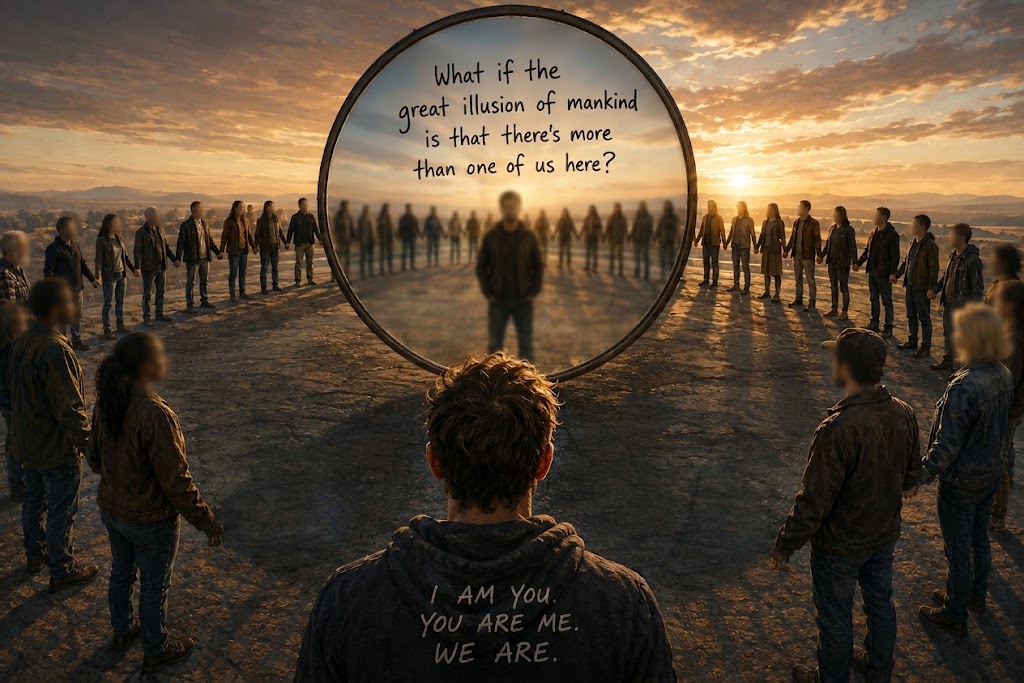
At this point in my life, I was reading a lot of Buddhist and Hindu writings and teachings. I’ve always been a seeker, and perhaps it was synchronicity that led me to those writings during that time. I became obsessed with the Hindu creation story, or at least Alan Watts’ telling of one, that says when God created everything, he split himself up into an infinite number of pieces and made those pieces human and gave them all amnesia under the guise of a game. The game was for each piece to remember that it, in fact, was part of a larger whole. That there was no “they” at all. This is when I first heard a quote that is often mis-attributed to Einstein: “What if the great illusion of mankind is that there’s more than one of us here?” It is a beautiful idea, whoever said it.
And this all brought me to the idea: What if there’s nothing wrong with me at all, aside from my addiction?
At some point, we started attributing everything to addiction and completely lost sight of the message of ego deflation at depth. This narcissistic, overly pathologized presentation of the normal human ego. The one that says addiction is an excuse for basic traffic rage. It’s just another wall, another defense mechanism, this tendency to wrap regular human self-centeredness in a special diagnostic label instead of just calling it what it is: ego.
Ego deflation, however, is becoming right-sized, no better than, no worse than. Understanding that, there is no difference between you and me. Ego is not inherently bad at all. It just is, and we all have one. And we all struggle with keeping it in check; people in recovery are not special.
Like with everything, however, I couldn’t see this for myself until I was ready. I leaned heavily on the idea of personal inventory in all its various incarnations. The spot-check. The annual. The semi-annual. The nightly. And on and on. And personally, I found this caused me more internal harm than good. It’s exhausting, always looking inward, and a contradiction in the program. The constant state of introspection seems to be the antithesis of the intent of the steps and the goal of looking outward or altruism. If I’m always taking my temperature, of course I think I’m sick. If I think I’m sick, how am I ever going to get better?
This seems to be the heart of the model: keep them sick, keep them coming back.
I learned a skill many years ago in a train-the-trainer class I was attending. The basic premise is: it’s easy to sell someone their own idea, so tell them something in a way that they think it’s their own idea. And when treatment centers and sponsors tell someone they are sick and broken when they walk in the doors, they believe it. Because they are sick and broken. What they don’t know, however, is that it’s not terminal. The terminal diagnosis is made in the rooms, and when that’s all someone who is new hears, they believe that too. And the cycle is self-perpetuating from that point on. I am the problem. I am sick. Keep looking inward. An ego-feeding proposition, the newcomer’s own idea. And on and on we go.
None of this absolves me. The onus of being a better person is still on me; it’s on everyone. Being an alcoholic or an addict does not make me different.
I don’t know if it’s generational or the time and place I grew up or just how I’m built, but I appreciate when people are blunt. I do not take it as rude usually, but I have my moments. I had a sponsor early in my sobriety who said, “If you want to stop feeling shitty, stop doing shitty things.” There was no fluffy talk about asking for “God’s help” or inventory or how I’m just prone to be an asshole because of a genetic predisposition to…whatever. Just a simple, hey dumbass, don’t be an asshole today. Then and now, that seems fair enough.
That’s what I need. Not as someone in recovery, but just as a human, to be right-sized, just one among many. I can’t be helpful to anyone when I still think I’m different somehow. I’m just another human being trying the best I can to leave this place a little better than I found it. I suspect you are as well.
Read Next
The Digital Diatribe runs on black coffee, hopes, and dreams. Unfortunately, keeping the lights on also costs actual money. If you like what you read and feel like buying me a coffee, I’d appreciate it. No pressure.
Want to know when the next post goes live? Subscribe for notifications. Subscribing is always free.

Leave a Reply