In 1994, grunge was still all the rage, but I wanted to play thrash metal. And while my guitar heroes all played ESPs, I wanted a PRS—specifically a green Custom 24, because that’s what my guitar teacher had. He wasn’t my guitar hero. I honestly cannot recall his name at this point in my life, but he was nice and a good teacher. But that guitar—well, it was the most gorgeous piece of wood I had ever seen. On the rare occasion I got a chance to play it, I did. I think that’s why I hung out at that music shop all the time: just waiting to play a guitar I could never afford.
Fast forward a few years to 2002, and my world had changed and changed again. I was married, living in Parker, CO, and had not even owned a guitar in several years. My dreams of being called up to fill in at a Metallica gig were long gone, and I was working as a satellite TV installer for $11 an hour. Even at 75–80 hours a week, we were struggling to eat, so buying a guitar was out of the question.
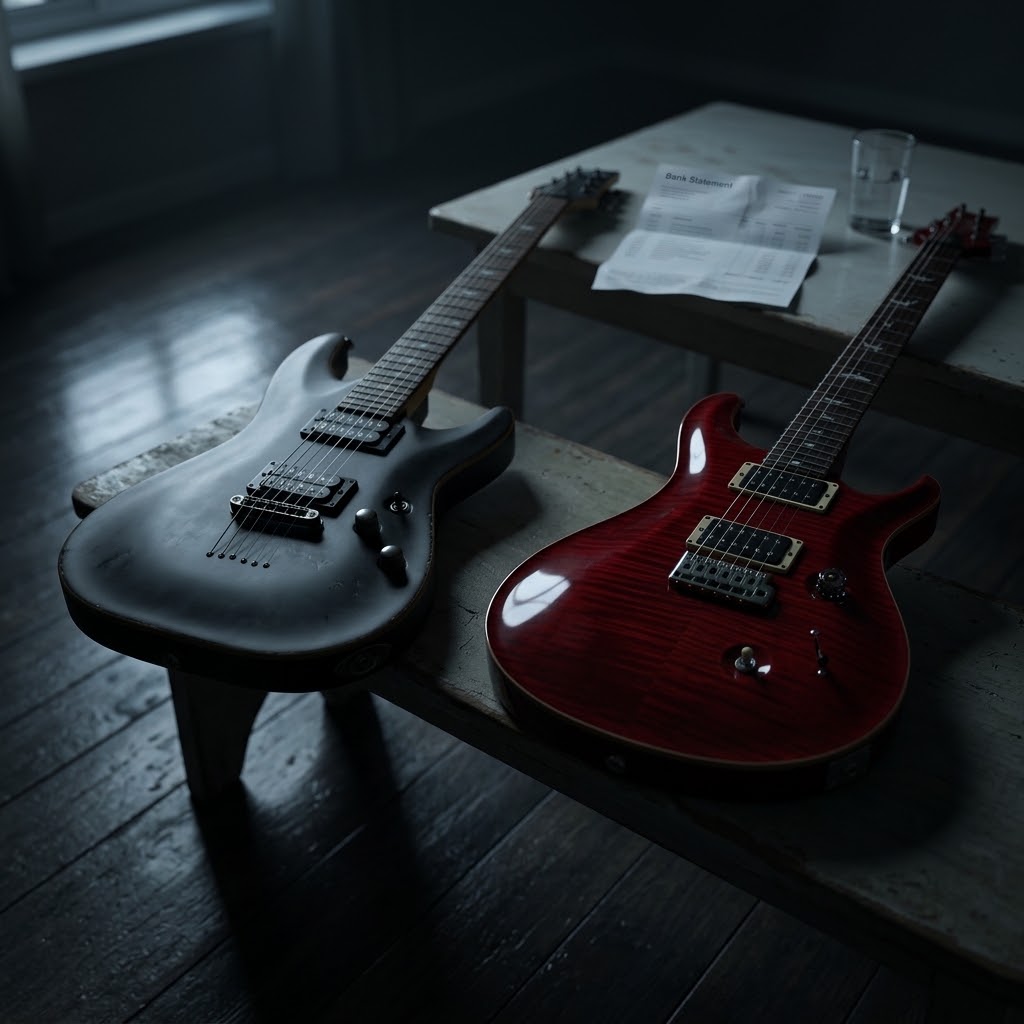
I sold all my instruments to pay some bills. One day, on one of my rare days off, Stacy and I went to Guitar Center, mainly so I could go play guitar. This was the only time I could play since I no longer owned one. I picked up this Schecter Omen-6 that I spotted as soon as we walked in the door; I absolutely loved it, and I sat there and played it for the next two hours. It was $197.00, and that was an insurmountable amount of money to spend on a “want.” So we left, and I silently daydreamed about it for the next six months.
On Christmas morning, I woke up to that guitar, and it made me cry. I couldn’t figure out how she had gotten the money for this thing that I was dying to own but was hopelessly out of my price range. This thing I never spoke about, but she knew, and she made that silent dream a reality. –Fragmented: The Crossroads of Trauma, Addiction, and Recovery
By February 2007, I was flush with cash and lost in a way I did not have words for.
I had settled a civil suit several months earlier regarding my wife’s murder. I was making substantially more than $11 an hour—more than I would make again for several years, in fact. I had done very well in the stock market, and I had just quit my job in the middle of a conference call.
On my way home, I stopped at Guitar Center and bought that PRS I wanted in 1994, except it caught my eye in red this time. In 1996, that guitar sold for around $2,400.00. That afternoon, I spent a little over $6,000.00 and didn’t even notice my checking account move, and I hated myself for it.
“Blood money.” That was what my head screamed at me every time I saw a bank statement, and every time, I wanted to die. One of the many things I never spoke about. Not about the money—not that I had it, at least. My fiancée at the time knew about it, but I told no one else. I’ve never felt more ashamed about anything in my life than I felt about that settlement. –Fragmented: The Crossroads of Trauma, Addiction, and Recovery
I don’t know why I sued the apartment complex owners. I mean, I know they were culpable and people encouraged me to do so. No one made me. The decision was mine. But nothing changed; she was still dead, and I felt more guilty than ever. The day we settled, I had been flying back and forth to Denver from Chicago for two years every couple of months for criminal or civil proceedings, and I was just done. I just needed something to be done, and this was something I could control, so I took the settlement and walked away. But there was no peace to be found.
So, at 28, I was a widower, unemployed, moderately wealthy, and a full-blown alcoholic struggling with dissociative amnesia—only I didn’t know it. The stage was set for mistakes to be made, and I did not disappoint.
The part I could not get past for a very long time was this: Stacy spent six silent months saving for a $197 guitar because she knew I wanted it and would never ask for it myself. I spent one afternoon in 2007 not even noticing that $6,000 left my account. By then, the money didn’t feel like mine in any way that mattered. It existed because of what happened to her. Spending it fast wasn’t really buying something—it was getting rid of it before it could sit in my account and remind me why it was there. Before it could remind me that I had settled on a price for her memory.
She never got to see a version of me with money. She got the years when a $197 want took six months of secret saving, when we shared one car between two jobs because that’s what the budget allowed. I got the years after: a settlement, a stock portfolio, a career nobody would have predicted for a guy who dropped out of middle school. None of it meant anything, because the one person who’d actually earned the right to see it wasn’t there to see it. That’s not poetic. That’s just the math of it, and the math never once came out even.
I’ve talked to enough people since to know I wasn’t the only one carrying this particular shame. Other widows. Other widowers. People who got a payout after a wrongful death, an accident, a lawsuit they never wanted to file. Nobody warns you about that part. Grief books cover the stages, the fog, the anger. Nobody hands you a pamphlet on what to do with a number in your bank account that only exists because someone you loved is gone. You’re supposed to feel grateful for the security. You’re supposed to feel relief that at least that part is taken care of. Instead, you feel as if you have betrayed them—or at least I did—and there’s no support group for that.
I still have the Schecter. Stacy’s guitar, the one she saved for in secret and gave me on a Christmas morning when we could barely afford anything. It lives in my house permanently now, handed down to my oldest son with one rule attached: it never leaves. Some money buys you an object. She bought me something I still can’t put a price on. I think that’s the actual difference between the two guitars. Not what they cost. What it cost each of us to get there.
If I still have your attention, subscribe. It will not cost you anything. Also, leave a comment and share this with someone else if you think it would be helpful. You’ll get emails anytime I post anything new. If you want to read this entire story, you can pick up a copy of the book here.
The Digital Diatribe runs on coffee, hope, and dreams. The newsletter and subscriptions are free and always will be. If you would like to help keep the lights on so we can keep doing this, however, you could buy me a coffee: https://buymeacoffee.com/digital_diatribe
Thanks for reading and following me on this journey. As always, I look forward to your comments.
Leave a Reply